
The quantification and verification of how much atmospheric carbon dioxide is ultimately removed by an ocean-based carbon dioxide removal (CDR) project relies on the use of modeling systems. This is why we set out to build C-Star—we saw a need for a standardized, open-source modeling toolkit for building, running, and sharing ocean simulations that could be used for ocean-based CDR research and project quantification. Along the way, we’ve found that C-Star has value beyond just ocean-based CDR; many regional ocean modelers are eager for a system that is faster and easier to set up and configure, shareable with colleagues, is actively supported, and is paired with both orchestration and diagnostic capabilities.
Today we’re excited to release our newest version of C-Star: a regional modeling system that is easy to configure in new locations, to audit and reproduce simulations, and that facilitates multi-scale numerical simulations of ocean alkalinity enhancement (OAE) and direct ocean removal (DOR). This release features an expanded set of scientific, methodological, and technical modeling capabilities, as well as features to help ease the friction of setting up and running regional ocean model simulations.
What is C-Star?
An ocean modeling study brings together many moving parts: the ocean model, the biogeochemistry, the input datasets, the boundary conditions, and the workflows that connect them. C-Star is an open-source toolkit that helps researchers manage those pieces, with UCLA-ROMS and MARBL at its core. We are building C-Star to provide an open-source modeling tool to support OAE, DOR, and other ocean applications.
Three basic principles have guided this development: lowering the technical barriers to configuring and running regional biogeochemical ocean modeling at locations around the world, ensuring simulations can be audited and reproduced, and developing the features needed to do state-of-the-science ocean-based CDR modeling.
C-Star Capabilities
This release brings together scientific capabilities and software improvements to make ocean simulations easier to set up, run, and reproduce. The capabilities below support each stage of a modeling study, from preparing a regional domain to connecting simulations across scales and sharing the work for independent review.
Build regional model configurations. Generate grids and prepare initial conditions, boundary conditions, atmospheric forcing, rivers, and tides through a guided wizard interface, or get hands-on with each input using the Python-based ROMS-Tools package.
Simulate ocean CDR. We’ve built the C-Star version of the ROMS model from the UCLA-ROMS code base. We’ve added a dedicated OAE and DOR forcing module and outputs as well as a dual carbonate chemistry system for robust CDR additionality calculations provided by MARBL.
Connect across scales. Use nesting and CDR upscaling to connect higher resolution near-field simulations with larger ocean domains.
Use controlled schemas for reproducibility. Share blueprints and workplans that record code versions, datasets, settings, and workflow choices, supported by hashes and run logs.
Use orchestration to automate a modeling study. Connect input generation, spin-up, experiments, and analysis through workflows that manage dependencies and track execution (read more below).
Updated ROMS code base. Additional scientific options, automated testing, and improved data handling to make the modeling system more reliable, efficient, and easier to maintain and extend as a community tool.
Robust scientific inputs. New scientific features include options for open biogeochemical boundary conditions, integration with the latest physical and biogeochemical river datasets, and automated download and regridding of climatological reanalyses and ocean model data.
A workflow manager built for ocean modelers
In C-Star, we’ve built an orchestration system around the concept of applications, blueprints and workplans—allowing a user to orchestrate (and replicate) an entire sequence of model runs, data transformations, and analyses on laptops and multi-node high-performance computer (HPC) systems. We have built in capabilities for real-world modeling challenges, with support for nesting and upscaling between domains, modifying model settings during spin-up periods, automating simulation restarts and continuation for multi-year runs, and more.
Modularizing these elements and developing a controlled schema is one of the unique features of the C-Star system. It is what enables auditability and reproducibility of both complex modeling simulations as well as complex workflows. The C-Star command line interface (CLI) provides a powerful and user-friendly interface to the entire system.
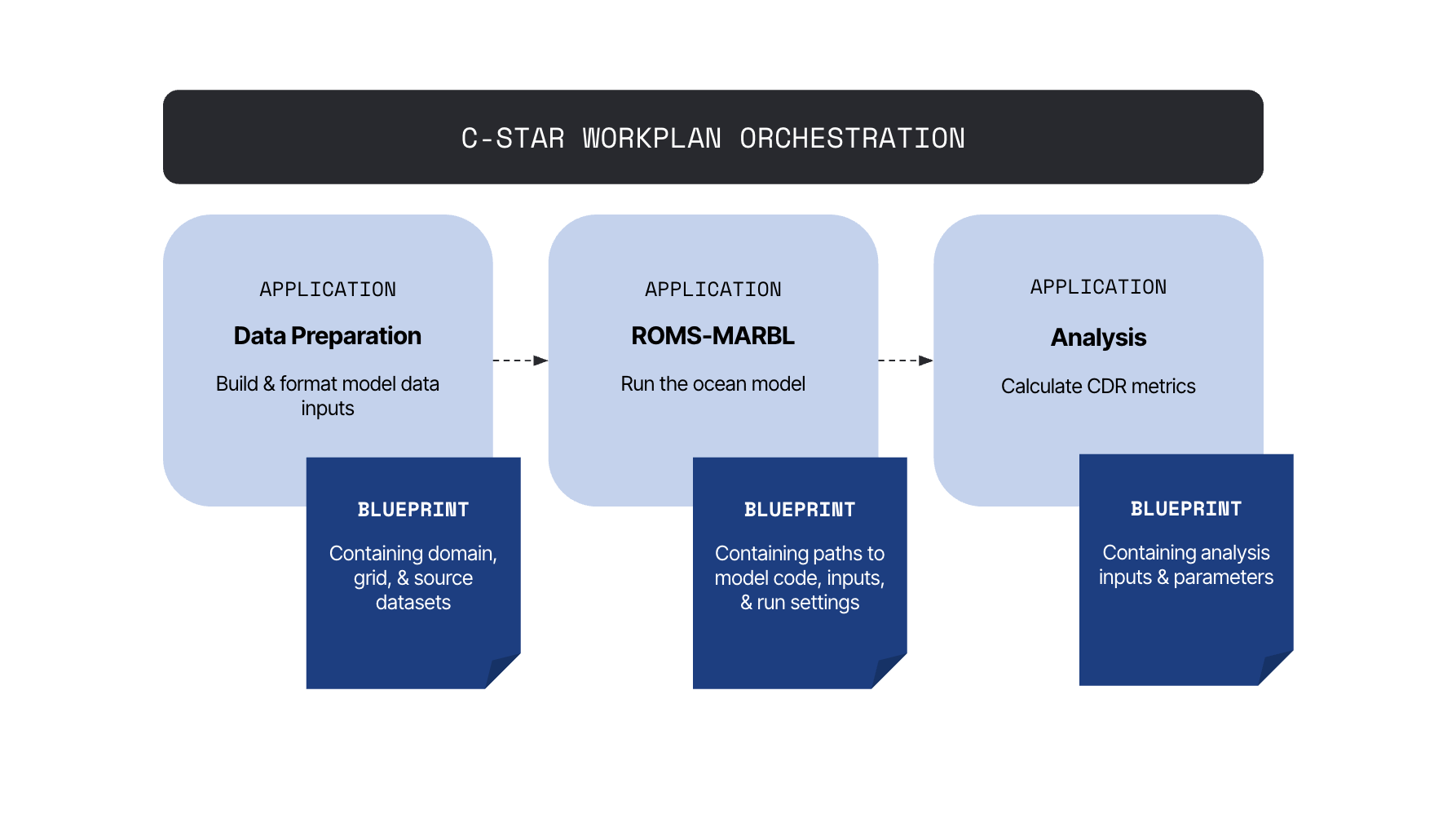
A blueprint provides reproducible inputs for an application. Applications are orchestrated by a workplan.
Applications. C-Star is built around a flexible and extensible concept of “applications”. An application could be an ocean model, a data transformation, an analysis package—any piece of software that you want to run. We provide a number of applications for configuring a ROMS domain, processing input files, running ROMS-MARBL, and performing analyses—and you can create your own custom applications to meet your scientific and workflow needs.
Blueprints. Every decision needed to run an application is in a blueprint. For example, the settings and parameters that govern a ROMS application (model choices, forcing datasets, and more) live in a single blueprint. Blueprints are a powerful concept because they allow you to generate reproducible model inputs and results each time you run. You can share your blueprints with colleagues, or use them as an auditable record of the inputs and choices that led to a model result. We’ve also developed an easy-to-use Blueprint Wizard to help you create blueprints in an interactive user interface.
Workplans. Workplans allow you to orchestrate any number of applications. A workplan strings applications together into a full project: a model run, a nested CDR domain, and the resulting analysis. You can set dependencies and the order of steps, and C-Star will run them in sequence or parallel, and report on their status as they run and complete. Set up your workplan, and let the C-Star orchestrator handle the rest.
Command Line Interface. Runnable on SLURM-based HPCs or your personal laptop or cluster, the CLI is an ocean modeling command center: access a high-level summary of all of your simulations, monitor the progress of your running jobs, dive into logs, fix and resume failed runs, and more.
The potential for agentic interaction with C-Star. Distilling the scientific complexity of regional ocean modeling into a set controlled schema and scientifically approved “tools” provides a path toward agent interaction with C-Star.
Try C-Star
We’ve compiled these resources to help you get started:
Read the docs.
Try a tutorial. Go from install to your first simulation, right on your laptop.
Join our live webinar on December 2, where our team will demo C-Star, then take your questions and hear about your use cases. Register today.
What’s next
We are expanding the scope of C-Star to include a range of models, including simple, near-field numerical testbeds, more cost-effective formulations of the geochemical component, and support for high-fidelity regional ocean modeling on modern computing infrastructure. Here are things we expect to include in upcoming C-Star releases:
Simplified approach to modeling OAE and DOR at lower computational cost (CDR-LiTE)
A validation and analysis suite for model-model and model-observation comparisons, usable as a stand-alone package or automated in your workplans.
Updated biogeochemical river inputs and lateral boundary condition datasets
Near-field and process models to help researchers understand plume mixing, biogeochemical processes, and alkalinity losses around an intervention.
Experimental examples of using natural language interfaces to integrate with C-Star.
Offline mCDR calculations leveraging the GLORYS12V1 Global Ocean Physics Reanalysis distributed by Mercator Ocean International
Evaluating Oceananigans and other ocean models as additional “plug-and-play” applications that utilize the same blueprint and workplan frameworks.
Updates to ROMS to run on modern computing architectures.
Follow us on LinkedIn and Github to stay up to date with our development and releases.
Acknowledgements
We’re grateful to the current and former members of the [C]Worthy team whose work made this release possible.
The C-Star version of ROMS is built on the UCLA-ROMS code-base and would not have been possible without the foundational work and continued innovations of our collaborators at University of California, Los Angeles: Pierre Damien, Jeroen Molemaker, Daniele Bianchi, James McWilliams, and members of their lab. We’re grateful for their ongoing partnership and their generous contributions to the development of C-Star.
We also thank the researchers, modelers, and partners who tested early versions of C-Star (Jessie Vance, Faycal Kessouri, Gustavo Marques, Elizabeth Yankovsky) and shared feedback along the way (Max Holloway, Will Burt, Sophie Chu, Jeanine Ash, Daan Reijnders, Mallory C. Ringham, Andreas Macrander, Angel Ruiz Angulo, Veronica Tamsitt, Jing He, Jen Yin, Stefano Cappello). Many of the features in this release and our plans for the future grew out of those conversations.
We have also benefited greatly from people who have personally championed our vision for C-Star: Adam Marbletone, Anastasia Gamick, Marc Von Keitz, Tom Kalil, Dai Ellis, Jed Sundwall, Alicia Seiger, Kishore Hari, V. Balaji, Heidi Cullen, Lexa Skrivanek, and many others.
The development of C-Star is made possible by direct C-Star project support (Environmental Defense Fund, Ocean Resilience and Climate Alliance, U.S. Department of Energy), general operating funds (Chan Zuckerberg Initiative (Biohub), ClimateWorks Foundation, Crankstart, Founders Pledge, Grantham Foundation for the Protection of the Environment, Navigation Fund, Patrick J. McGovern Foundation, Stripe) and scientific and applications development grants that enable ongoing scientific innovation (Alfred P. Sloan Foundation, Carbon to Sea Initiative, Frontier Climate, National Oceanic and Atmospheric Administration).
